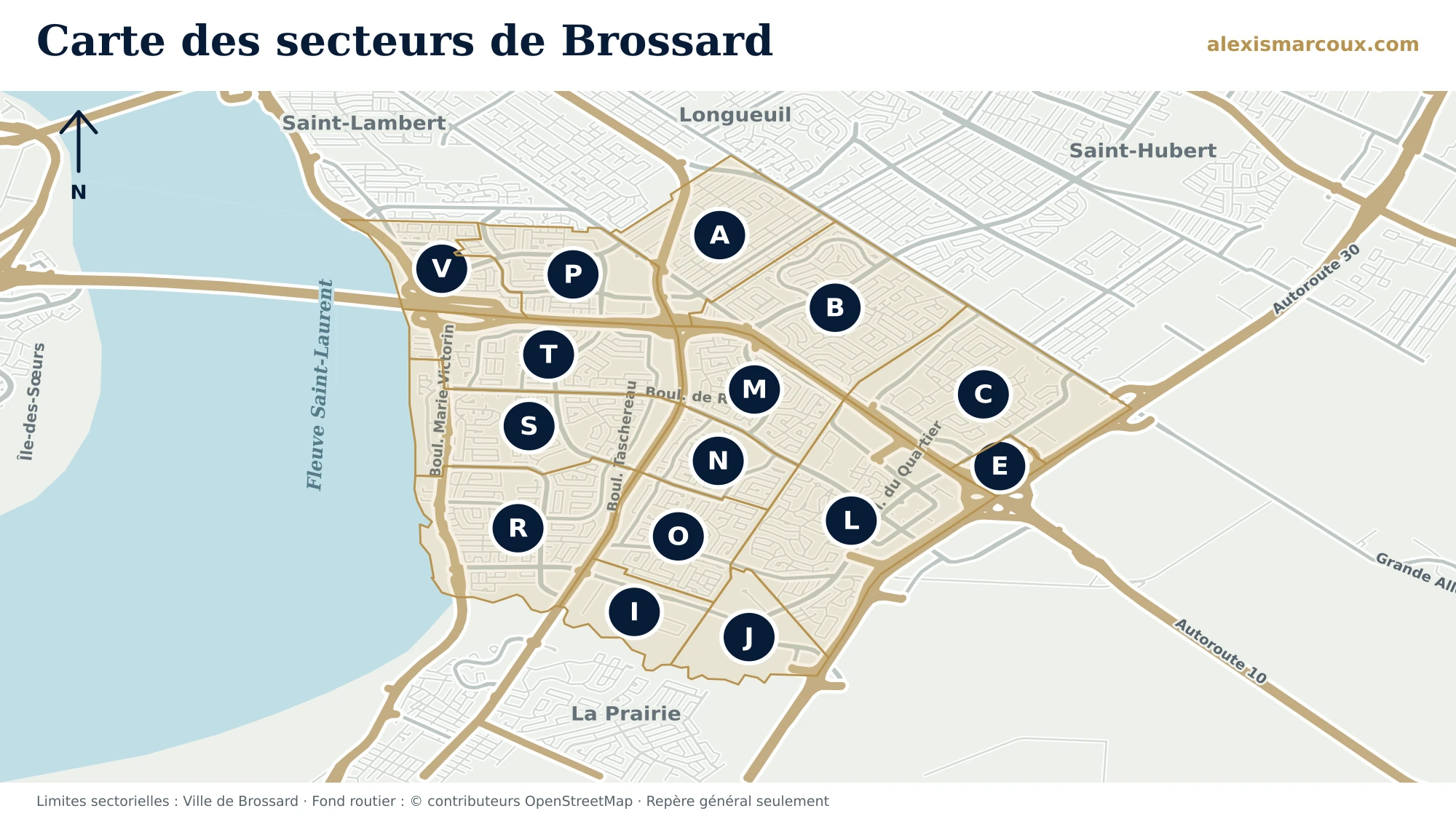
Choosing a Brossard neighbourhood involves more than comparing addresses. Property type, REM access, nearby services, the pace of the area and daily travel can significantly change the buyer experience.
Updated:
Key takeaways
- Travel : compare door-to-door trips from each address at the times you will actually travel.
- Budget : include condo fees or house maintenance, taxes and transportation.
- Location : the street, building and documents matter as much as the sector letter.
Understanding Brossard’s sectors
Brossard’s lettered sectors are useful local reference points, but they do not replace analysis of a specific address. One area may include several construction periods, building types and levels of access to services. Lifestyle should be the first filter, followed by budget and property type.
A proper comparison should also account for road and natural boundaries, immediate surroundings, traffic, schools, parks and the actual walking or transit distance. Two homes marketed as being near the REM may provide very different experiences.
Compare neighbourhoods through your daily routine
Before choosing a sector letter, identify the two criteria that will make a real difference in your week. Use this grid to compare actual addresses; it does not rank neighbourhoods from best to worst.
| Priority | What to compare | On-site check |
|---|---|---|
| Using the REM | Walking, buses, transfers and parking costs, depending on the route. | Travel from the property door to the platform, then to your destination. |
| Having outdoor space | Private yard, balcony or shared terrace; upkeep and usage rules. | Check sunlight, privacy and access from living areas. |
| Simplifying family routines | Routes to school, daycare and activities, rather than their mere presence on a map. | Test crossings and rush-hour trips; confirm school assignment. |
| Reducing personal maintenance | House repairs or condominium fees and shared repairs. | Read maintenance records and documents; identify upcoming work. |
| Staying within a complete budget | Housing, transportation, upkeep, insurance and a contingency allowance. | Compare two properties using the same expense categories, not just asking price. |
Advertised proximity or a city-wide average does not replace address-specific checks.
Solar and DIX30: a distinct hub
Around Solar Uniquartier and Quartier DIX30, housing leans more toward condominiums, recent developments, services and mobility. Du Quartier station directly serves this hub, which should be analyzed separately from the R and S residential sectors closer to the river.
This environment may suit buyers who prioritize travel to Montreal and proximity to restaurants or shops. Before buying, it remains important to assess noise, traffic, parking, nearby projects and the quality of the condominium documents.
Sectors R and S: established neighbourhoods near the river
Sectors R and S are in the part of Brossard oriented toward the St. Lawrence River. Parc Radisson, Parc Sorbonne, mature streets and varied housing create distinct micro-markets.
A property near the water, an established home near a park and a condominium should not be compared mechanically. The detailed Sector R and S guides explore those differences.
Sectors N and P: recreation and family living
Sector N is shaped in part by Parc Poly-aréna, Brossard’s main outdoor sports hub. Sector P is anchored by Parc Victorin, its pool, water play area and family amenities.
In both sectors, established properties should be compared by age, renovations, street and actual distance from amenities. The detailed N and P guides explore those differences.
Sectors T and M: mobility and mature neighbourhoods
Sector T now benefits from a multi-use link to the Samuel De Champlain Bridge and landmarks such as Parc de la Terre and Parc Champlain. Sector M offers a more mature residential fabric around neighbourhood parks such as Malo and Maupassant.
These differences influence travel, daily life and the comparables that should be selected. The detailed guides analyze each area at the micro-location level.
Sectors O and V: parks and local living
Sector O is anchored by family hubs such as Olympia, Océanie and Sainte-Marie parks. Sector V stands out for its distribution of many smaller parks and green spaces throughout a mature residential fabric.
In both cases, stated proximity should be confirmed from the address and considered alongside the street, building and household’s actual needs.
Sectors B, E, I and J: four distinct profiles
The large Sector B includes several micro-neighbourhoods and many parks. Sector E corresponds to the Solar urban hub, while I and J stand out through their relationship with the Saint-Jacques River and outdoor settings.
These areas should never be compared through a single average. The detailed guides explain buildings, lots, condominium considerations and setting-specific checks.
Established areas near Panama and Taschereau
Established areas around Panama and portions of Taschereau Boulevard often offer homes from different periods, mature streets and practical access to services. Panama station is also a major connection point for RTL buses.
For an older property, inspection and renovation history become more important. Roofing, drainage, foundation, plumbing, electrical systems and improvement quality should be considered in relation to the asking price rather than in isolation.
Sector C and family-oriented areas
Sector C is notably associated with the Grand parc urbain, a large natural and recreational space, as well as several nearby facilities. Its residential environments may appeal to buyers seeking more space, parks and a family-oriented daily routine.
The presence of a school or park does not guarantee that an address meets every need. School catchments may change, and distances should be verified directly. Visiting at different times remains one of the best ways to assess the true feel of a street.
A simple method for making the right choice
Start by ranking your priorities: travel time, property type, desired maintenance, outdoor access, services, schools and full monthly budget. Then visit two or three different environments so that you compare more than interior finishes.
Finally, analyze each property using comparable sales from its immediate area. There is no universally best neighbourhood: the right one meets your needs without requiring you to overlook building, condominium or financing risks.
Your comparison notes after showings
For each of your two or three shortlisted properties, record the same details while the showing is fresh in your mind. Missing information becomes a question to resolve before making a decision.
- Must-haves : which needs are met, and which compromise will affect you every day?
- Travel : what time did you actually measure, and what is your backup route?
- Costs : which expenses are documented, estimated or still unknown?
- Repairs : what needs further review by an inspector or specialist?
- Comparables : which recent sales genuinely resemble the building and its location?