Planning a purchase, a small rental building or a heating upgrade? The November 5, 2026 federal budget and updated heat pump information are worth a closer look. Checked on November 9, this review separates future measures, proposals and steps you can prepare now in Quebec.
Key takeaways
- New triplexes and fourplexes : new parameters announced for insurance applications submitted from February 1, 2027.
- Down payment of at least 20%: a $1.5 million limit is proposed for the default insurance a lender chooses to obtain.
- Purchase restrictions for non-Canadians : the extension to 2029 remains a proposal.
- Heat pumps : possible retroactive eligibility from November 1, 2026, with applications expected in early 2027.
The dates that matter for your plans
An announcement does not automatically change your loan or eligibility. These are the four measures’ statuses as of November 9, 2026. The mortgage announcements and the proposal on purchase restrictions for non-Canadians date from November 5; heat pump retroactivity starts November 1.
| Topic | Status | Relevant date |
|---|---|---|
| Financing to build or buy a new triplex or fourplex | Announced parameters, upcoming | Applications from February 1, 2027 |
| Default insurance for mortgages with a down payment of at least 20% | Budget proposal | No implementation date announced |
| Restrictions on residential property purchases by non-Canadians | Proposed extension | Proposed end date: January 1, 2029 |
| Federal rebate for installing a heat pump | Possible retroactivity, portal upcoming | Installations from November 1; portal early 2027 |
New triplexes and fourplexes: up to 90% over 30 years
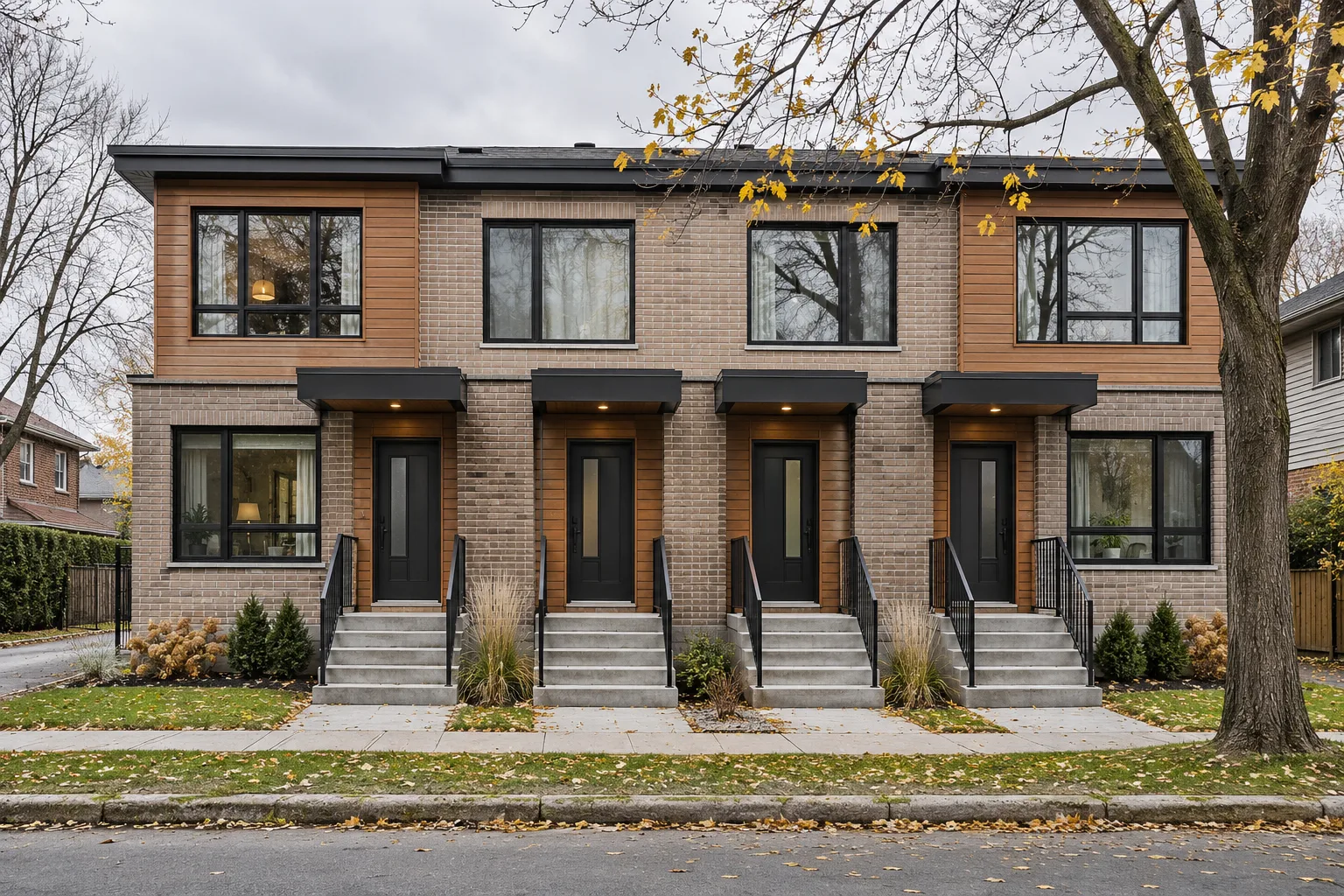
Finance Canada’s published parameters cover construction or purchase of an eligible newly built three- or four-unit property. Financing could reach 90% of projected value at completion, with no property-value ceiling or owner-occupancy requirement. The announced maximum amortization is 30 years.
The measures apply to applications lenders submit to insurers from February 1, 2027. Long-term financing has maximum gross and total debt-service ratios of 39% and 44%, plus the minimum qualifying rate. At least one borrower or guarantor needs a credit score of 600 or more. Construction financing itself follows insurers’ own underwriting criteria, without the same maximum-amortization and debt-servicing requirements.
Considering a new multiplex on the South Shore? Confirm the lender’s product and accepted property value before setting your budget. This change does not extend to all existing multiplexes. Financing also does not grant permission to build: municipal zoning and permits need separate verification.
With a down payment of 20% or more, what does optional insurance mean?
This is mortgage default insurance: it protects the lender if the borrower fails to repay the mortgage. It is the same type of protection used for an insured loan with a smaller down payment. It is separate from the life or disability insurance sometimes offered with a mortgage.
With a down payment below 20%, federally regulated lenders generally must insure the mortgage. With at least 20%, that requirement no longer applies, but a lender may choose to insure an eligible loan or make insurance a condition of its offer. Optional therefore refers to the lender’s choice. Once that insurance is obtained, the loan is an insured mortgage.
Why is the $1.5 million figure appearing again? Since December 15, 2024, that limit has already applied to eligible homes financed with insured mortgages and a down payment below 20%. The November 2026 proposal concerns insurance for loans with a down payment of at least 20%, whose general home-price limit remains $1 million. The budget proposes raising it to $1.5 million and allowing 30-year amortizations if at least one borrower is a first-time buyer or the home is newly built. No implementation date has been announced.
For example, a $1.2 million home with a $240,000 down payment would require a $960,000 loan before other costs. That purchase can already be financed without default insurance if you qualify. The proposed change would allow the lender to insure that loan despite the home’s $1.2 million price. The limit concerns the eligible home’s price or value, not the loan amount. Any effect on your rate or approval will depend on the lender’s product.
| Your down payment | General rule and home-price limit |
|---|---|
| Less than 20% | Insurance generally required. Home price below $1.5 million under the rule in effect since December 2024. |
| 20% or more | Lender may choose to insure an eligible loan. Home price below $1 million under the current general framework; raising the limit to $1.5 million is only proposed. |
Comparison for a standard residential purchase. Other loan, property and insurer requirements also apply.
Purchase restrictions for non-Canadians: proposed extension to 2029
Ottawa proposes extending the prohibition on certain non-Canadian purchases of existing residential properties to January 1, 2029, while exempting new residential properties. This is a budget proposal, not a new exemption buyers can already use.
The current framework has a January 1, 2027 end date and already includes exceptions, including permanent residents and certain qualifying temporary residents. Your status, the property type and its location matter. Before signing a promise to purchase, have a notary or lawyer review your situation rather than assuming newly built homes are already exempt.
Heat pumps: preparing a retroactive application
The National Heat Pump Rebate was announced October 8. November updates provide for possible retroactive eligibility for installations from November 1, 2026. The portal is expected in early 2027. No payments will be made before launch and application approval; parameters remain subject to change.
The announced rebate is $2,000 for eligible households above median income, or up to $10,000 for low- to median-income households, depending on equipment cost. Thresholds vary by household size and province. For a two-person Quebec household, the published threshold is $82,097 in after-tax income under the program’s calculation.
- Check the model and AHRI number against the official list and confirm that the system can heat the whole home.
- Purchase and installation must be through an HVAC contractor. Keep detailed invoices and track the stated six-month deadline for receipts.
- Only one rebate is available per household, even with several properties. A rental home may qualify; an address that previously received federal heat pump funding is excluded.
Moving your Quebec real estate plans forward
For a purchase, establish your borrowing capacity using the rules and products actually available when you apply. For renovations, compare quotes and verify assistance before counting a rebate in your budget. Proposals can inform a future scenario, but your commitment should rely on confirmed conditions.
Looking to buy or sell in Montréal, on the South Shore or in Montérégie? I can help you compare properties, organize the steps and prepare a strategy suited to your plans. We can also identify questions for your lender, notary or contractor. Alexis Marcoux, residential real estate broker.
Sources and useful links
- Finance Canada: November 5, 2026 parameters for new multiplexes
- Federal Budget 2026, chapter 3: loan insurance and purchase restrictions for non-Canadians
- Eligible Mortgage Loan Regulations: separate limits in sections 5 and 6
- Finance Canada: high- and low-ratio loan insurance, March 2020 quick facts (French)
- Financial Consumer Agency of Canada: life insurance and default insurance (French)
- OACIQ: current purchase prohibition and exceptions
- Canada: heat pump rebate, retroactivity and income thresholds
- Finance Canada: December 2024 reforms taking effect